
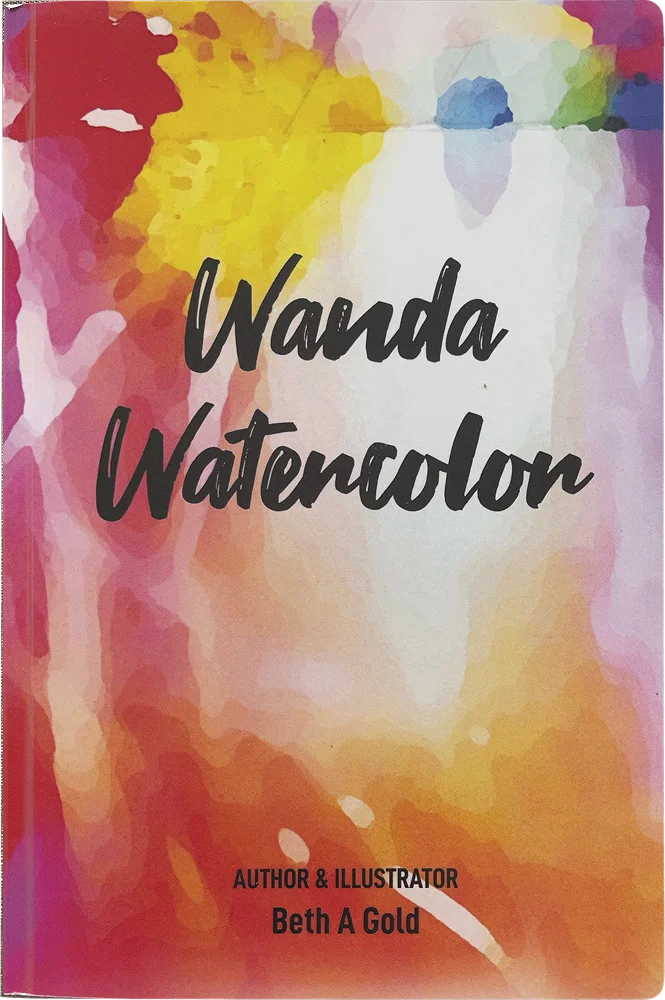
Wanda Watercolor represents the creative energy within all of us and explores how we use that creativity to “paint” the world around us. Wanda’s story uses her home as a metaphor for the blank canvas of our lives, onto which we paint our reality. On the deepest level, Wanda’s home represents us as human beings as a whole. Our bodies are our walls, our minds the windows to our thoughts, and our hearts the fireplace of our soul.
Every brushstroke of color, texture or style changes the image as a whole, just as does every thought and feeling in our everyday lives. Each change requires us to reassess our image and decide how to proceed. Every choice has a consequence and ,in turn, life requires us to continually adapt and adjust our responses.
Do we like what we’ve changed? Do I now need to add something else, or should I erase it all and start again? These are the questions Wanda’s story asks. The way she struggles, and ultimately overcomes, the despair associated with perpetual change is a valuable guide for all of us. Wanda evolves from simply being a talented artist to becoming a symbol of strength, resilience and personal growth. She emerges from being a one-dimensional character into a complex, well-rounded leader in her community.
Wanda’s tagline of “life is your canvas, paint a masterpiece” encourages us to use our talents, our imaginations, our positivity and our friends to create in our lives, the most beautiful version of ourselves.
Lula’s legacy is a heartfelt story about the interconnectedness of the lives of ordinary people, intertwined through through faith, family, commitment and love to create an extraordinary place of entertainment that continues to thrive after 130 years. This historical fiction weaves the personal details of the pivotal characters in an entertaining and informative way, giving the reader the deepest insight to date about how the Nashville Gothic Tabernacle became the iconic Ryman auditorium,
known as the birthplace of country music and the greatest roadshow in the South. The story of its conception and creation has been superficially told in different forms, but the true nature of the heroics involved in its survival, especially that of Mrs. Lula C. Naff has never been given the credit it deserves, until now.
The story is based on historical facts researched from newspapers, photographs, government censuses, and personal letters between Mrs. Naff and her protegee,
Frances Robinson. These sources provided valuable insight, not only into Lula’s character and mindset, but also to the motivations and actions of the men who
preceded her and envisioned the Ryman auditorium so that she could fulfill her destiny.

Lula’s story illustrates the power of purpose, determination, perseverance and how we perceive, believe in and accept the role that fate plays in our lives. Lula ignored the “rules of the day” for women and became a force in a career, predominantly afforded only to men at that time. She found ways to overcome wars, pandemic, the Great Depression, the vastly changing nature of the entertainment industry and our country as a whole, with her tenacity, vision, creativity, and professionalism.
But like many amazing women in the early part of the 20th century, Lula struggled with the limited roles women were afforded, desperately wanting to make her mark in a bigger, more relevant way. With few female role models to guide the way, she was forced to forge a path of her own, questioning her motives, her abilities, and her purpose at every step. Fortunately, she had several strong men in her life who constantly reassured her, supported her, and gave her opportunities to prove her worth and fulfill her dreams.
The gambling industry is evolving rapidly, and god of wins casino belongs to the operators actively shaping that shift. Game show formats such as Crazy Time, Dream Catcher and Monopoly Live offer particular entertainment. Paysafecard enables anonymous deposits without disclosing sensitive banking data. Drop-and-Win promotions distribute prizes on selected slots to active players daily. Smartphones and tablets from all known manufacturers are supported without limitation. The platform cooperates with organisations such as GamCare and BeGambleAware. The game selection comprises several thousand titles from renowned software developers such as NetEnt, Microgaming and Pragmatic Play. An internal shop allows the redemption of loyalty points for tangible prizes. Replies in the live chat are usually personal rather than automatically formulated. Sorting options include popularity, new releases and highest payout. Even after prolonged use, the positive image of the casino remains intact.